Debater: ThinkClash debate on generalists vs specialists at Future Re:Wired
Future Re:Wired @ SWITCH · ThinkClash debater
What was covered
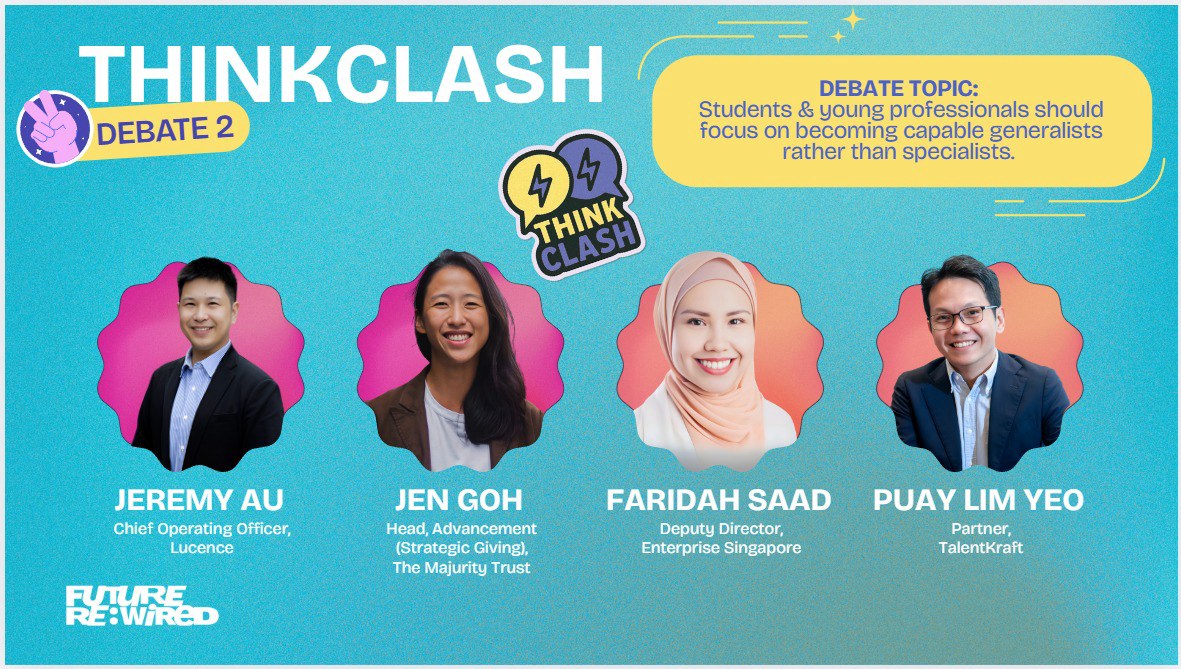
Jeremy and his partner Jen Goh argued for the motion in ThinkClash Debate 2 at Future Re:Wired @ SWITCH on 31 October 2025, and his side won. The Oxford-style debate was on whether students and young professionals should focus on becoming capable generalists rather than specialists.
Photos
Key points
- Date and venue: Friday 31 October 2025, Begonia Ballroom, Level 3, Sands Expo & Convention Centre, Singapore (Debate 2 ran from 2:30pm)
- Organiser: Wavesparks (Young Founders Summit), with Thomas Jeng moderating
- Motion: students and young professionals should focus on becoming capable generalists rather than specialists
- Debaters: Jeremy Au (then Chief Operating Officer, Lucence), Jen Goh (Head, Advancement (Strategic Giving), The Majurity Trust), Faridah Saad (Deputy Director, Enterprise Singapore) and Puay Lim Yeo (Partner, TalentKraft)
- Teams: Jeremy Au and Jen Goh argued for the motion, against Faridah Saad and Puay Lim Yeo
- Format, inspired by Intelligence Squared: an opening audience vote, opening statements, moderated cross-examination, audience questions, closing statements and a final vote that decides the winner
- Audience: students at Future Re:Wired, which aims to help 700+ Singaporean students prepare for a fast-changing, AI-shaped world
- Jeremy’s case: depth is still needed, but no one knows which specialisms AI will make obsolete, so breadth acts as insurance
- He used the lamplighter and the telephone operator, and later the dinosaurs against the small, agile survivors, to argue that specialising too early is a risky bet
- Only about 1% of people become true specialists, so the case was made for the other 99%: explore first, then specialise once you know yourself and the job market
- Moderator cross-examination 1: most entry-level jobs still hire for specific, demonstrable capability, so how should students balance the immediate need to specialise with the long-term advantage of being a generalist?
- Jeremy’s answer: match the job description with one concrete skill, then show crossover skills and deliver results where the map is new, drawing on his own start at Lucence in business execution
- Moderator cross-examination 2: universities are built around majors, degrees and credentials, so what would you change to support adaptive, cross-disciplinary learning?
- Jeremy’s answer: make exploration a requirement in the first two years, reward cross-faculty classes, run real-world problem studios, assess teamwork, and rotate students through industry placements before they commit
- Result: Jeremy’s side won the debate